David Nolen of MSU will be the featured speaker
![]() |
| David Nolen, professor Mississippi State University |
Sharing news, research, stories, and other material by Roscoe Barnes III, Ph.D. Research topics include F.F. Bosworth, Ernest Hemingway, Anne Moody, and Natchez, MS. Email: roscoebarnes3@yahoo.com
David Nolen of MSU will be the featured speaker
![]() |
| David Nolen, professor Mississippi State University |

Anne Moody's book, "Coming of Age in Mississippi," has remained in print since the first day it was published in December 1968.
CENTREVILLE, Miss. — The Town of Centreville has been approved for a Mississippi Freedom Trail marker that will honor the legacy of Anne Moody and her work in the civil rights movement of the 1960s, announced John Spann, program and outreach officer for the Mississippi Humanities Council.
Spann shared the news Thursday, Dec. 14, following a meeting of the Freedom Trail Scholarly Review Committee.
The memorial to Moody will be the first Freedom Trail marker erected in Wilkinson County. The location has not been determined, but it will be posted in 2024, according to Spann.
The Mississippi Freedom Trail was created to commemorate the people and places in the state that played a pivotal role in the American Civil Rights Movement. As of Dec. 14, a total of 35 new markers have been approved. The Freedom Trail markers are managed by the Mississippi Humanities Council, with partnership and funding provided by Visit Mississippi.
![]() |
| Anne Moody (1940-2015) Photo by Jack Schrier |
Moody’s family, along with Centreville residents,
business and community leaders, were ecstatic about Moody receiving a Freedom
Trail marker.
“This is exciting news,” said Frances Jefferson, Moody’s sister. “This will certainly help the current generation to understand the importance of her work for civil rights and her legacy.”
Felicia Williams, Moody’s cousin and former Centreville Alderwoman, said the marker will be good for Centreville and for Wilkinson County.
“I was elated to receive a phone call informing me that Anne Moody would be honored on the Mississippi Freedom Trail,” she said. “This is not just an honor for her and her family but also for the Centreville community. Anne suffered greatly for a cause in which she believed in and a cause that now allows African Americans to live the long talked about American dream.”
Moody, who was born and raised in Centreville, was a civil rights activist and the author of “Coming of Age in Mississippi,” which chronicles her life as a poor Black girl growing up under Jim Crow. The book also provides riveting accounts of her work in the struggle for civil rights.
In raw details, Moody wrote about the sacrifices that she and others made in the fight for freedom and justice. She also recounted the challenges and threats she faced during nonviolent protests to register voters and desegregate public spaces.
In 2021, her work as a writer was officially recognized on the Mississippi Writers Trail. A historical marker recognizing her work was posted and unveiled in The Louis Gaulden and Riquita Jackson Family Memorial Park in Centreville.
Moody died at her home in 2015 at the age of 74. At the time of her death, she was living in Gloster, a small town located nine miles north of Centreville.
The Reverend Larry Lee, former mayor of Centreville, said he is happy to see Moody recognized on the Freedom Trail.
“The Mississippi Freedom Trail Marker for Anne Moody is a great honor to mark the trail blazed through her sacrifice and contribution during the Civil Rights Movement,” he said. “Anne Moody is an icon for those who wanted justice, freedom and hope for communities suppressed by the challenges of racism in Mississippi. I am grateful to the Committee for choosing to bestow such a great honor in memory of Anne Moody.”
Guy McNabb, president of the Centreville Chamber of Commerce, agreed. “This is great news!” he said. “Centreville Chamber of Commerce is honored to have given our letter of support for a historic event such as this.”
McNabb said the chamber is proud to be a partner for this project.
Support for the marker was echoed by Centreville Town Clerk Kimberly Montgomery. “This is wonderful news,” she said. “Although we were hoping to recognize Mr. Samuel O’Quinn with this significant marker, I am equally thrilled to further recognize the works of Anne Moody.”
Montgomery said the new marker will undoubtedly “help to keep the history of Centreville relevant.”

Photo by Chrissy Wilson
Woodville African American Museum
See more at: https://listenupyall.com/2023/12/15/civil-rights-pioneer-anne-moody-to-be-part-of-the-mississippi-freedom-trail/
NATCHEZ, Miss. -- The building once used as a meeting place for the Natchez Deacons for Defense and Justice will be the site of a second Mississippi Freedom Trail Marker in Natchez, announced John Spann, program and outreach officer for the Mississippi Humanities Council. He shared the news Wednesday, Dec. 13, following a meeting of the Freedom Trail Scholarly Review Committee.
Spann said the committee felt the application for the
marker, which was prepared by the Natchez Civil Rights Trail Committee, was
“compelling” and the site was “definitely deserving of being on
the Freedom Trail.”
The building is located at 319 N. Dr. M. L. King St.
(formerly Pine Street). It is a two-story wood-frame structure that housed the
Donnan’s Barbershop on the first floor in the 1960s. The barbershop is where
the Deacons organized in September 1965 under the leadership of President James
“Big Jack” Jackson, who worked as a barber.
“We are excited to bring the story of the Deacons for
Defense to the Mississippi Freedom Trail,” said Spann. “Stories like theirs
give a different perspective of the movement that is seldom discussed. It’s
important to the Freedom Trail Committee to add markers that uplift unknown
people, events, and nuance essential to the Mississippi freedom movement.
Telling this story of organized armed defense of civil rights activity and
leaders of this state, fits our mission.”
Willie Carter, who worked as a shoe-shiner in the
barbershop in the early 1960s, and later as a barber, is the current owner of
the building.
When he worked at the site, the building was owned by
Leon Donnan, he said. According to Ser
Seshsh Ab Heter-Clifford M. Boxley, a former Deacon, Donnan “was extremely
influential on the civil rights strategy.”
Carter said he was happy to learn that Donnan’s
Barbershop is being recognized for its role in the civil rights movement in
Natchez. “I am grateful,” he said. “It
gives me great pride to know that this barbershop was allowed to be part of the
Natchez movement that enabled Black people to have freedom and be recognized in
the society.
“I appreciate the contributions of the people in our
community whose work and sacrifices got us to where we are today. I’m also
thankful that Leon Donnan allowed the Deacons to use his barbershop for their
meetings. I’m grateful to have been a part of this important movement.”
Mayor Dan Gibson suggested the recognition is one of many
ways in which the city of Natchez is working to tell its complete history.
“Since the beginning of our administration, we have been
working to tell a more inclusive history of Natchez,” he said. “Up until then,
our city was not even listed as on our state’s Freedom Trail or on America’s
Civil Rights Trail. This now will be the second marker placed in Natchez in
less than one year, placing us solidly on both trails. I am so grateful. And I
applaud the work of those who have been working to make this happen. Telling
our whole story is key to bringing our city together as One Natchez.”
Natchez’s first Freedom Trail marker was unveiled in
April this year at the Dr. John Banks House at 9 St. Catherine St. In 1965, the house served as the headquarters
for the Natchez Branch of the NAACP. It was also the home of NAACP George
Metcalfe who used it as a boarding house for civil rights workers.
NAPAC Museum Director Bobby Dennis said the announcement
of Donnan’s Barbershop being recognized is good news for Natchez. He suggested there is much to be told about
this barbershop and the people who came through it.
“It was a gathering place of civil rights workers and
educators, as well,” he said, noting many prominent people in the African
American community frequented the door of the barbershop. “The barbershop was
the hottest spot for most of the people who had any role in the civil rights
movement,” he said.
The Deacons for Defense was a civil rights
paramilitary organization of African Americans who provided armed protection
for civil rights workers and the Black community. It was founded in 1964 in Jonesboro, La., in
response to the terror and violent acts of the Ku Klux Klans against civil
rights activists.
The Natchez Deacons organized soon after the attempted
assassination of NAACP George Metcalfe, whose car was bombed by members of the
Ku Klux Klan on Aug. 27, 1965, in the parking lot of Armstrong Tire and Rubber
Company. Metcalfe survived the bombing with major injuries.
In a February 2022 interview, Boxley said Donnan’s
Barbershop played an important role in the civil rights movement. He said it was a command post and observation
point used by the Deacons to keep an eye on the Klan, among other things.
Boxley said the Deacons aided the Natchez movement in
becoming one of the most successful movements in the South. Because of this success, Natchez became a
model for other communities in Mississippi.
According to historians, the impact of the Natchez Deacons was
felt throughout the state as they established chapters in other areas,
including Wilkinson and Jefferson counties.
Historian Akinyele Omowale Umoja noted: “The Natchez
Deacons became an essential ingredient in the Natchez and the Mississippi
movements…..Without a doubt, the Deacons made the Natchez and Mississippi
movements more effective.”
The Mississippi Freedom Trail was created to commemorate
the people and places in the state that played a pivotal role in the American
Civil Rights Movement. As of Dec. 14, a
total of 35 new markers have been approved.
The Freedom Trail markers are managed by the Mississippi Humanities
Council, with partnership and funding provided by Visit Mississippi.
Read more at: https://www.natchezdemocrat.com/2023/12/14/donnans-barbershop-building-approved-for-mississippi-freedom-trail-marker/
See full article here: https://shorturl.at/ahoR8
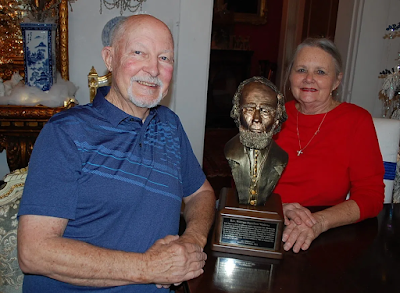
NATCHEZ, Miss. – Despite facing a serious storm on Monday evening, a group of friends and visitors came out to see the unveiling of Bob Willis’ bust of the Rev. William Hamilton Watkins (1815-1881) at Sunnyside Bed & Breakfast at 102 Rembert St.
Watkins was the Civil War-era preacher who built
Sunnyside as a parsonage in the 1850s. As pastor of Jefferson Street Methodist
Church, he was known as a preacher of conviction and the minister who conducted
the funeral service for William Johnson, the “Barber of Natchez,” in 1851,
according to Wilkins.
“There is a story with Rev. Watkins,” said Wilkins. “We
dedicate our tours to talking about the history of Rev. Watkins. After I saw
his bust, I knew this would be just the thing to put an exclamation point on
the end our story. We can now point to the bust and say, ‘This is a likeness of
him sculpted by Bob Willis.’”
Willis is a retired pastor and grief counselor who lives
in Oklahoma. He’s been a sculptor for almost 30 years. He and his wife, Lynn,
are frequent visitors to Natchez, a place, he said, they absolutely love. Over
the years, he has sculpted several important figures from the city’s history.
Earlier this year, Zion Chapel A.M.E. Church commissioned
Willis to sculpt a bust of Hiram Rhodes Revels, the first African American to
serve in the U.S. Congress. Revels was also an early pastor of Zion Chapel and
the first president of Alcorn A&M College, which is now Alcorn State
University, in Lorman. The church unveiled Revels’ bust during a special
ceremony on Sept. 30.
Wilkins said she learned of Willis’ work through her
friend, Ann Elizabeth Kaiser, who oversees The Manse at 307 South Rankin. The
Manse houses three of Willis’ sculptures.
“She wanted me to meet him and so she brought him over,”
Wilkins recalled. “He showed me pictures of some of the things he’s done. It’s
unbelievable what he can do.”
In a recent post on Facebook, Kaiser commented on a photo of Watkins’ bust shared by Wilkins. “Amazing!” she wrote. “We have so many historical figures in Natchez to remember! Your tourists at Sunnyside will surely love and appreciate this beautiful art piece along with learning about Dr. Watkins. Perfect for our tourism industry! Can’t wait to see the sculpture in person!”
| Colleen Wilkins, owner of Sunnyside Bed & Breakfast, displays bust of the Rev. William Hamilton Watkins, that was sculpted by Bob Willis of Oklahoma. |
Colleen Wilkins, owner of Sunnyside Bed & Breakfast,
displays bust of the Rev. William Hamilton Watkins, that was sculpted by Bob
Willis of Oklahoma.
Wilkins said the bust will be placed in the entryway of
Sunnyside. “I want everyone to see what beautiful work Willis does and
hopefully have a bust sculpted of someone they love and respect. I think
anybody who sees his work will be amazed.”
Watkins was born on April 11, 1815, in Jefferson County.
Willis said he was an ordained Methodist Episcopal minister who served
congregations in Natchez, Woodville, Jackson, and Vicksburg. He also served for
two years as president of Centenary College in Jackson, La. (now located in
Shreveport, La).
Watkins and his wife, Elizabeth, had eight children.
During the Civil War, he was arrested for treason and spent time, possibly
several months, in a prisoner of war camp until the end of the war.
Wilkins recounts his story as follows:
When the Union troops were camped at the top of the hill
at Rembert and St. Catherine streets, a Union soldier by the name of Jones
became friends with the Watkins family. Watkins’ daughter, Hattie, fell in love
with him.
One day Jones was nearby when Confederates came to
Watkins for assistance. They ask if he would contribute money, food, arms, and
clothing to the Confederacy. Watkins agreed to help. His oldest son was
fighting in the war, and he hoped that some of his contributions would get to
his son.
Jones, however, reported Watkins to the Union Army, and
in 1865, Watkins was arrested and charged with treason. According to reports,
he was roughly treated. He reportedly said that he had never been so deceived
in his life as by Jones.
During his trial, the commandant told Watkins that the
crimes for which he was charged are punishable by death. Watkins replied, “I
know nothing of the laws of war, only the gospel of God.”
Watkins’ bail was set at $10,000, which is equivalent to
about $188,755.21 in 2023. Because he only made $1,100 a year
(about $20,763.07 in 2023), he could not come up with the money.
Consequently, he remained incarcerated until the end of 1865, when he was
released along with the POWs. Once released, he went on to minister in Jackson,
Vicksburg, Woodville, and other places.
Watkins died on Feb. 5, 1881, in Jackson. He was 65.
He is buried at Cane Ridge Cemetery in Lorman, Miss.
https://listenupyall.com/2023/11/22/sunnyside-presents-bust-of-its-builder-rev-william-watkins/
By Roscoe Barnes III Natchez, MS, USA / ListenUpYall.com Aug 21, 2026 | 1:01 PM ArtsNatchez Gallery recently donated $500 worth of art sup...