Monday, January 29, 2024

Natchez Historical Society honors Smokye Joe Frank at 2024 Annual Dinner Meeting

By Roscoe Barnes III
The Natchez Democrat
Published 4:45 pm Friday, January 26, 2024


Smokye Joe Frank, left, is the winner of the 2024 Historic Preservation Award. It was presented to him Tuesday, Jan. 23, at the 2024 Annual Dinner of the Natchez Historical Society held at the Natchez Grand Hotel. He is pictured here with his wife, Carol, and their son, Brandon.

NATCHEZ — Joseph “Smokye Joe” Frank received a standing ovation Tuesday night as the recipient of the 2024 Historic Preservation Award at the 2024 Annual Dinner of the Natchez Historical Society.  A total of 109 people turned out for the event which was held at 7 p.m. on Jan. 23, at the Natchez Grand Hotel. 

It was the second time in the society’s history – and second year in a row — that the dinner drew more than 100 people. Last year, just over 100 people attended during a major thunderstorm. 

 “Tuesday night’s attendance was probably the largest we’ve ever had, with last year being the second largest,” said Maria Bowser, former president of the society. “It was an outstanding evening. We appreciate the weather gods holding off and the tremendous support we received from our community. Don’t ever think history is dead.” 

From 5:30 to 8:30 p.m., the audience enjoyed food and fellowship as they celebrated Natchez history.  Leaders of the historical society welcomed a new board member and presented financial reports.  

Presentations were given by Dr. Stuart Rockoff, executive director of the Mississippi Humanities Council and David Nolen, professor at Mississippi State University, who was the featured speaker. 

Adam Gwin, vice president of the society’s board of directors, introduced Frank before presenting him with the preservation award, which honors individuals or organizations who have made a significant contribution to historic preservation or the study of history within the Natchez area. 

“All of us who know him know of his love of history and historic material culture,” Gwin said. He noted Frank, a retired archaeologist and historian, got his start in archaeology digging at The Grand Village of the Natchez Indians under Robert Neitzel and went on to work at other Natchez sites.  

Gwin said Frank’s knowledge and love of Natchez’s history know few bounds. Frank accepted the plaque and thanked the society for the recognition. 

The plaque is inscribed with the words:  “Natchez Historical Society Proudly Presents THE PRESERVATION AWARD to Smokye Joe Frank For Significant Contributions to Historic Preservation, January 2024.” 

‘A good year’ 

Gwin welcomed Daye Dearing as a new board member, who will serve as the program chair, beginning in 2025. She is replacing Alan Wolf, who is completing his term. 

Gwin also acknowledged the generosity of Jim Johnson and Geoff Butcher, owners of The Carriage House at Myrtle Terrace, who donate their guest house to the society for out-of-town guests. They’ve hosted all of the speakers who have come during this and the past season, according to the society. 

During the business portion of the meeting, Al King, the society’s treasurer, said 2023 was a good year for the nonprofit organization.  He said the value of its investment account grew by 15 percent. 

According to King, the society’s records show a total of $9,400 in income receipts and a total of $10,500 in expenses. A major purchase during this period was a speaker system for monthly meetings, King said. Funds also went toward the building of a new website for the society. 

King reported the society’s total ending net assets at $286,166. “This is our second highest funding year,” said Bowser, noting the highest was in 2021 with total ending net assets at $289,330. 

King said the society was grateful to the Mississippi Humanities Council for the $2,400 grant it awarded in support of the society’s programs. Rockoff, who leads the humanities council, shared a few words about the council’s commitment to the humanities in Natchez and throughout Mississippi. 

“This past year, the Mississippi Humanities Council gave out 47 grants, 21 of which went to organizations we haven’t granted to before,” Rockoff said. “The Natchez Historical Society is one of these. I’ve been so impressed with how active and thoughtful the society is. The roster of speakers is truly outstanding and we are proud to help support it.” 

Rockoff explained that the council is an independent, nonprofit organization supported by the National Endowment for the Humanities and also by grants and donations. 

‘Catching the Rabbit’ 

Nolen, professor and associate dean for Archives and Special Collections at Mississippi State University, was the featured speaker. He spoke on the topic, “Catching the Rabbit: U.S. Grant and the Vicksburg Campaign.” 

The idea for his topic originated in the July 2, 1863, issue of The Vicksburg Daily Citizen, in which a story dismissed Grant’s plan to end the siege of Vicksburg with its capture by July 4.  The newspaper suggested, “The way to cook a rabbit is ‘first to catch the rabbit.’”  After Vicksburg’s defeat, the Union troops reported, “Gen. Grant has ‘caught the rabbit.’”

Nolen said that “catching the rabbit” is a fitting metaphor for the entire Vicksburg campaign. 

Bobby Dennis, executive director of the NAPAC Museum, said he enjoyed the night’s program. “We didn’t know that Grant went to Raymond before going to Vicksburg,” he said. “We’re always interested in human stories and other facts related to African American history. Mr. Nolen’s presentation filled in some of the gaps on the history of the Colored Troops. It was very informative.” 

Bowser praised Nolen’s talk. “He spoke for us in 2022 and he returned by popular demand,” she said. “He was twice as wonderful this time.” 

“He was an energized speaker on a timeless topic,” said Betty Jo Harris, history instructor at Copiah-Lincoln Community College in Natchez. “It is why General Grant’s assault on Vicksburg is still studied today at West Point.”

Rev. Tracy Collins of Rev’s Country Tours said Nolen’s talk was extremely informative and pleasurable. “I enjoyed his presentation and I enjoyed the company of other people who like history,” he said. “I think the talk on Grant and Vicksburg was enlightening.”

Read more at: https://www.natchezdemocrat.com/2024/01/26/natchez-historical-society-honors-smokye-joe-frank-at-2024-annual-dinner-meeting/


Saturday, January 20, 2024

Benefitting Beulah: Beulah Missionary Baptist receives National Trust for Historic Preservation grant

By Roscoe Barnes III
The Natchez Democrat

Members of Beulah Missionary Baptist Church said they are sincerely happy about the grant awarded by the National Trust for Historic Preservation. From left are Rev. Dr. Johnathan T. Hargrave, pastor; Robert Morgan, deacon; and Carter Burns, executive director of Historic Natchez Foundation. Burns said the foundation is proud to have assisted the church with its application for the Preserving Black Churches grant.
Note: This story appears in the Sunday, Jan. 21, 2024, issue of The Natchez Democrat (pages 1A and 6A).

NATCHEZ, Miss. – Beulah Missionary Baptist Church has been awarded a $150,000 grant by the National Trust for Historic Preservation. The funding is through the Preserving Black Churches program of the African American Cultural Heritage Action Fund. It will be used for the restoration of the steeple and windows of the 111-year-old structure, according to church officials.

The church was “overjoyed” at the news, said the Rev. Dr. Johnathan T. Hargrave, the church’s pastor, who learned of the news on Monday, Jan. 15. Hargrave said the restoration work is “significantly needed” and the grant will make it all possible.

“Beulah has been a beacon in our community for many years, and now we can continue to let our light shine by preserving this great historic establishment,” he said.

“I am elated,” said Deacon Robert Morgan. “I’m so thankful to God for showering blessings on us. With Beulah being a small congregation, this is truly a blessing. This shows that God answers prayer.”

Beulah Missionary Baptist Church

Beulah was founded in 1896 by William Rochester, a U.S. Colored Troops veteran and commander-in-chief of the Mississippi and Louisiana Department of the Grand Army of the Republic. The church played a pivotal role in organizing for civil rights in Natchez, as it hosted many meetings and rallies.

Beulah is located at 710 Beulah Street or B Street. It was one of 31 churches out of more than 550 applicants across the United States approved for funding by the National Trust for Historic Preservation, which awarded a total of $4 million for the institutions.

The funding aims to help preserve Black churches by addressing ”urgent preservation threats such as deferred maintenance and demolition, but also to strengthen their ability to steward, interpret, and fund these invaluable places and the people they serve,” according to the organization’s website.

Carter Burns, executive director of Historic Natchez Foundation, said the foundation is proud to have assisted Beulah Missionary Baptist Church with its application for the Preserving Black Churches grant.

“We are always on the lookout for grant money, and it is particularly difficult for churches to get funding,” he said. “The steeple and windows on this important landmark building are in dire need of repair and this grant will facilitate their restoration.”

Mayor Dan Gibson praised the foundation and Beulah for their work in pursuing the grant and the vision they have for improving the church and interpreting its history.

“This is truly a prayer answered,” Gibson said. “When I first learned that the steeple of this historic church was in poor condition and might eventually have to be taken down, I became hopeful that somehow grant funds could be sought. And now to learn that the Historic Natchez Foundation, working with Beulah Baptist Church, has successfully obtained this substantial grant is truly a blessing.”

Gibson said the grant “underscores the positive things happening in our community, One Natchez, working together to preserve and better tell our whole story.”

In terms of the Beulah’s history, Hargrave said that while the church was officially organized on Dec. 30, 1896, its original wooden edifice was constructed in 1901. On March 4, 1911, it was destroyed by fire and rebuilt in 1912. Bricks and an annex were later added to the church, and in 2000, structural improvements were made but did not include restoration of the steeple, according to Hargrave.

“We are more than grateful for being awarded this grant to save our steeple from further deterioration,” he said.

In Hargrave’s view, Beulah is more than just an old church. “It has been noted as the central meeting place in Natchez during the civil rights movement,” he said. “Many activists have passed away, and the survivors of those treacherous times will be happy to see the continued efforts to keep the church open and looking great. Time has evolved us into a peaceful community where we can all live and worship together.”

Hargrave said he is thankful to Morgan and Burns, “who have been persistent and worked tirelessly toward assisting” with the project.

“We never gave up, and we continued to press forward on achieving this goal,” Hargrave said. “I am reminded of a Bible scripture, Isaiah 60:22: ‘When the time is right, I the Lord will make it happen.’”

Beulah Missionary Baptist Church was recently awarded a $150,000 grant by the National Trust for Historic Preservation through its African American Cultural Heritage Action Fund. The funding will be used for the restoration of the steeple and windows of the 111-year-old structure. Pictured in front of the church, from left are Robert Morgan, deacon; Rev. Dr. Johnathan T. Hargrave, pastor; and Carter Burns, executive director of Historic Natchez Foundation.


Monday, January 8, 2024

Revels sculptor earns award of merit

By Roscoe Barnes III
Special to The Natchez Democrat 

Zion Chapel A.M.E. Church of Natchez, Miss., celebrated the legacy of Hiram Rhodes Revels with a bust in his hoor during an unveiling ceremony on Saturday, Sept. 30, 2023. From Left are Natchez Mayor Dan Gibson; Harold Woodson Jr., great-great-grandson of Hiram Revels; Rev. Birdon Mitchell, pastor of Zion Chapel A.M.E. Church; and Bob Willis, sculptor of Edmond, Okla. Revels was the first African American to serve int he U.S. Congress. He also was an early pastor of Zion Chapel and the first president of Alcorn State University.

Note: This story was published on page 3A in the Sunday, Jan. 7, 2024, issue of The Natchez Democrat (Natchez, Miss.). For more information, visit NatchezDemocrat.com.

NATCHEZ, Miss. – Oklahoma sculptor Bob Willis has been named a winner of an Award of Merit for his bust of Hiram Rhodes Revels, which he sculpted for Zion Chapel A.M.E. Church in September 2023, announced Brother Rogers, secretary-treasurer of the Mississippi Historical Society. Rogers made the announcement on Friday, Jan. 5.
 
“The Mississippi Historical Society is grateful to Bob Willis for his sculpture of Hiram Rhodes Revels, who as the first African American U.S. senator is significant not just in Mississippi history, but in American history,” he said.
 
Awards of Merit are presented annually by the Mississippi Historical Society to individuals or organizations for their outstanding archival, museum, or media interpretation work.
 
Willis said he was surprised to learn about the award.
 
“I am truly humbled to receive this award from the Mississippi Historical Society,” he said, noting he was deeply moved by the news. “Sculpting the bust of Hiram Rhodes Revels was a project to capture a very significant person in the rich history of Natchez, the State of Mississippi, and America. His example of dedication and service to our country is something that needs to be recognized and honored.”
 
The bust of Revels was commissioned by Zion Chapel and Visit Natchez. The church unveiled the bust during a September 30 ceremony that drew more than 70 people, including several descendants of Revels, as well as Mississippi State Senators Robert Johnson and Albert Butler, and Mayor Dan Gibson.
 
“I can think of no one more deserving than Bob Willis for this high honor,” said Mayor Gibson. “Mr. Willis is not only a talented sculptor but a man who has a heart for people and for making sure we celebrate the history and contributions of all.
 
“This bust, portraying the great Hiram Revels, is a contribution not just to Zion Chapel where Senator Revels served as an early pastor, but a contribution to all citizens of Natchez who take pride in the heroic achievements of this great American. And we are very grateful to Mr. Willis for sharing his talent in such a selfless way.”
 
Norma West, who directed the unveiling ceremony, said the honor was well deserved. “We were excited to learn about this recognition given to Mr. Willis,” she said. “The bust he sculpted of Hiram Revels is truly amazing.”
 
The Rev. Birdon Mitchell, pastor of Zion Chapel, shared similar remarks: “As I said last year, we were all ecstatic that Hiram Revels, a former pastor of our church, the first president of Alcorn College, and the first person of color to serve in the United State Senate, was being recognized in our community through this great work of art.”
 
Mitchell said he is proud of Willis and very pleased to see his work being recognized by the Mississippi Historical Society.
 
Recipients of the Awards of Merit will be formally announced at the annual meeting of the Mississippi Historical Society that will take place on Thursday and Friday, Feb. 22 and 23, 2024, at The Inn at Ole Miss in Oxford.
 
The awards will be presented at the Awards Luncheon at 12:30 p.m., Friday, Feb. 23. Willis is invited to attend the luncheon.


Tuesday, January 2, 2024

Dr. Martin Luther King Jr. Day Parade slated for Monday, Jan. 15

By Roscoe Barnes III, Visit Natchez
Natchez, MS, USA / ListenUpYall.com
Dec 29, 2023 | 1:45 PM

Leola Harris and Chief Cal Green

NATCHEZ, Miss. – Retired educator Leola Harris and Natchez Police Chief Cal Green will serve as co-grand marshals for the 2024 Dr. Martin Luther King Jr. Day Parade, which is set for 3 p.m. Monday, Jan. 15, 2024, in downtown Natchez.

“This will be an exciting event and a great way to honor the legacy of Dr. Martin Luther King Jr.,” said Jacqueline Marsaw, who chairs the parade committee. “We will have a broad range of participation by individuals and by many different groups. We invite everybody to come out and be part of this important event.”

In addition to King, several people will be recognized for their work in the struggle for civil rights. Marsaw said the honorees include U.S. Rep. Bennie Thompson (D-Miss.); Philip West, former mayor of Natchez; Barney J. Schoby, the first black elected to serve on the Adams County Board of Supervisors; and the late Rev. Leon Howard.

“We want to honor those who fought for civil rights,” Marsaw said, adding their work should never be forgotten.

The parade is sponsored by The Natchez Branch of the NAACP. It is an annual event held for the entire Mis-Lou community.

Marsaw said the parade route will be the same as in 2023 and previous years, beginning with the lineup for the parade at 2 p.m. on Broadway Street.

The parade route will begin at North Broadway and Franklin streets and will travel along Franklin to N. Dr. M.L. King St., where it will turn left and proceed up to Minor Street, where it will end.

At the conclusion of the parade, trophy presentations will be given at the corner of Dr. M.L. King and High streets for the best float, the baddest vehicle, bands, and dance groups.

Both the float contest and vehicle contest will have first- through fifth-place awards presented, Marsaw said.

The deadline for registration to participate in the parade is Monday, Jan. 10, 2024

In a flyer distributed for promotion, Marsaw said that certain groups that participate are asked to make a donation of $50 “for unlimited entries.” These groups include churches, civic organizations, sororities, fraternities, Mardi Gras krewes, clubs and businesses, among others.

Motorcycle participants are asked to contact Lee Ford via Marsaw at 601-443-1350. Other entry fees include $10 for a single car or truck. The fee for horses is $5 per horse.

Marsaw said there is no cost or entry fee for the groups that provide entertainment for the parade. These groups include bands, the ROTC, and dance teams.

Anyone desiring to make a donation or pay an entry fee is asked to make all checks payable to the Natchez Branch NAACP and send them to Natchez Branch NAACP, P.O. Box 733, Natchez, MS 39120.

For more information on the parade, call Chairperson Jacqueline Marsaw at 601-443-1350.

See more here: https://listenupyall.com/2023/12/29/dr-martin-luther-king-jr-day-parade-slated-for-monday-jan-15/

Thursday, December 28, 2023

Honoring Natchez U.S. Colored Troops


I was honored to join Home with Heroes volunteers and the Wreaths Across America campaign in honoring the U.S. Colored Troops on Friday, Dec. 15, 2023, at Natchez National Cemetery. Here I'm pictured at the grave Landsman Wilson Brown, a Medal of Honor recipient.

Wednesday, December 27, 2023

Smokye Joe Frank is winner of 2024 Historic Preservation Award

By Roscoe Barnes III
Natchez, MS, USA / ListenUpYall.com
Dec 27, 2023 | 8:29 AM
Joseph "Smokye Joe" Frank is the winner of the 2024 Historic Preservation Award presented by the Natchez Historical Society.

NATCHEZ, Miss. – Joseph “Smokye Joe” Frank, a retired archaeologist and local historian, is the winner of the 2024 Historic Preservation Award presented by the Natchez Historical Society.

Karen Hill, the society’s president, shared the news at a recent board meeting.

“On behalf of the Natchez Historical Society, I am so pleased that we could honor Smokye Joe for his archaeological and historical contributions,” she said. “His work over the years has played a vital role in helping us to better understand and appreciate our history.”

The Historic Preservation Award honors individuals or organizations who have made a significant contribution to historic preservation or the study of history within the Natchez area.

When Frank learned of his selection for the award, he said he was flattered. “I Just turned 80 this year,” he said. “There are places I want to go and get back to in order to do the actual field work. But at my age, I simply can’t do it. This recognition makes a difference. It makes turning 80 not as bad. It makes growing old worthwhile.”

Frank said the last time he was surprised in this way was in 1980, when he was selected to sit on the Louisiana National Register of Historic Places Review Committee.

The preservation award will be presented to Frank at the society’s 2024 Annual Dinner at 7 p.m. Tuesday, Jan. 23, at the Natchez Grand Hotel, 111 N. Broadway St.

Frank currently serves on the Natchez Preservation Commission. He is also a tour guide at Elms Court and Hope Farm. He previously served as an officer with the Natchez Historical Society.

In 2004, the Mississippi Archaeological Society honored him as the winner of the Calvin J. Brown Award. Several years ago, he was also awarded the L.B. Jones award by the Mississippi Archaeological Association for his years of contributions to Mississippi Archaeology.

Frank’s work as an archaeologist in Natchez started in the early 1960s, a year after he graduated from Cathedral High School, where he played football.

“In 1962, Robert S. Neitzel, archaeologist, gave me a job digging at the Grand Village of the Natchez Indians,” he recalled. “That made up my mind. From then to the spring of 1970, I worked, went to school, and looked for Natchez Indian sites.”

For six years during the 1960s, Frank served with the Mississippi National Guard. In the spring of 1970, he graduated from Northwestern State University with a Bachelor of Arts degree in history and anthropology.

The next year found him working with Dr. Jeff P. Brain of the Peabody Museum, with whom he assisted with a Lower Mississippi Survey and spent his summer surveying the Natchez Bluff. During this time, he took college students to visit his sties. One of those students was Ian W. Brown, who is now professor emeritus in the Department of Anthropology at the University of Alabama.

Brown recounted: “In 1971 and 1972, Smokye was a major aid to Jeffrey P. Brain’s Lower Mississippi Survey’s operations surveying the Natchez Bluffs. This was a Peabody Museum, Harvard University project. It was at that time that Vin Steponaitis and I got to know Smokye very well, as he was constantly tracking down new sites for us.”

Brown said Frank also conducted research with Dr. Elizabeth Boggess, another respected archaeologist in Natchez. Boggess refers to Frank as her “colleague and dear friend.” She said that she was only a graduate student when they were assigned to check on all the previously recorded archaeological sites in this area.

“Over the years, I realize that I probably learned more from him than from any of my professors!,” she said.

In 1976, Frank graduated from Northwestern with a master’s degree in social studies with an emphasis on anthropology.

Frank’s work as an archaeologist can be seen in various locations in Natchez and Adams County. In 2015, he spearheaded efforts that resulted in the Adams County Board of Supervisors designating the portion of Lower Woodville Road — from Col. John Pitchford Parkway to the Sibley post office — as the Tunica Trail Tricentennial Bypass.

Frank said that what is now known as Lower Woodville Road was at one time a trail used by the Tunica Indians. “The early travelers labeled it the Tunica Trail,” he said.

Prior to this designation, Frank successfully led efforts to have Morgantown Road designated as the Natchez and Hamburg Railroad Company Memorial Byway.

In addition to his work in Mississippi, Frank served as an officer in the Southwest Louisiana Archaeological Society and in the newly formed Louisiana Archaeological Society.

During the 1990s, Frank worked with the Natchez Trace Archaeologist of the National Park surveying the last nine miles of the uncompleted development of the Natchez Trace Parkway into Natchez.

When surveying a site, “the goal is to determine whether human occupation ever occurred there,” Frank explained. He said the work involves, among other things, going out and selecting an area, looking at the land, walking the land, looking for artifacts, digging test holes, studying plants, studying geological information, and putting the information in a report.

Surveying also involves researching the history of the property, going back as far as one can, he said.

Since his retirement from the State of Louisiana in 2001, Frank continues to do research on various projects. In addition to looking for Natchez sites, he is retracing the Natchez and Hamburg Tracks.

Between 2001 and 2010, Frank assisted an archaeologist on sites on Fort Rosalie and The Natchez Trace.

Jessica Crawford, southeast regional director for The Archaeological Conservancy, and longtime friend of Frank, applauded his achievements.

“In 1971, he helped search for the Tunica Treasure, and he’s recorded hundreds of sites,” she said. “I know he deserves many accolades!”

For more information on the society’s 2024 annual dinner and the presentation of Frank’s award, visit natchezhistoricalsociety.org or call 281-731-4433 or 601-492-3004.


Filmmaker confirms the late Gwendolyn Johnson’s military service with ‘Six Triple Eight’

By Roscoe Barnes III
Natchez, MS, USA / ListenUpYall.com
Dec 27, 2023 | 8:16 AM


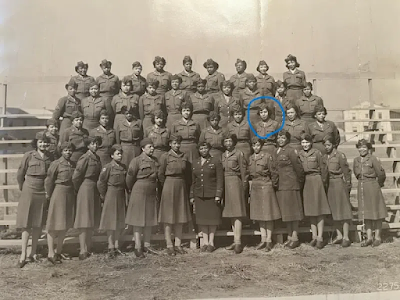
World War II veteran Gwendolyn Freeman Johnson is pictured here with members of her unit. She is in the second row, third person from the right.

NATCHEZ, Miss. – Filmmaker James William Theres believed for some time that the late Gwendolyn Freeman Johnson was a member of the World War II unit known as the “Six Triple Eight,” but his belief was based on anecdotal evidence. On Thursday, Dec. 7, 2023, Theres learned from Johnson’s military records that she was indeed a member of the mostly Black female unit that played a vital role in the war.

“This journey has been filled with excitement,” said Theres. “Working with the National Cemetery Administration to track down Mrs. Johnson’s service discharge record from 1946 was so rewarding.  And now working with the family to have her headstone reflect her military service is one of the highlights of my career.”

Ben Tucker, an Army veteran and volunteer with Home with Heroes, recently laid a wreath on Gwendolyn Freeman Johnson's grave during the Wreath Across America campaign.

Theres said his initial views about Johnson’s status were based on the research by Vietnam veteran Marsha Holder, who penned a biographical note about Johnson on Findagrave.com.

As a member of the 6888th, Johnson is posthumously awarded the Congressional Gold Medal for her service. The medal, according to Theres, is U.S. Congress’ highest expression of national appreciation for distinguished achievements and contributions by individuals, institutions or groups. The legislation for the medal was signed into law by President Biden in March 2022.

Johnson’s daughter, Nazarita Franklin of Vicksburg, said she was thrilled to learn about the recognition given to her mother.

“She would be very touched and proud of this honor,” she said. “It was not just about her, but over 850 other women who served. She was very proud of being a veteran, and she was very happy to go overseas. She kept a lot of pictures and different mementos from her time in the military.”

Nazarita’s daughter, Bridget Franklin of Memphis, said she was “incredibly proud” of her grandmother. “She told me different stories about her service when we were growing up. She was extremely proud of the work she did. This (medal) is a very nice honor,” she said.

‘No Mail, Low Morale’

Johnson’s records show that she was a Private First Class in the 6888th Central Postal Directory Battalion. According to Theres, she was one of the 855 women in the first and only predominantly black female battalion who served in Europe during World War II. Among other achievements, he said, her battalion cleared a two-year backlog of mail and helped process for delivery more than 17 million pieces of mail near the end of the war.

Image of Gwendolyn Freeman Johnson in military uniform during World War II. Johnson served with the 6888th Central Postal Directory Battalion, which is known as the "Six Triple Eight." It was the first and only predominantly Black female battalion that helped process for delivery more than 17 million pieces of mail near the end of the war.

Six Triple Eight” was the nickname given to Johnson’s battalion, whose motto was “No Mail, Low Morale.” The Army Women’s Foundation website notes: “The unit served at home and in Europe where they sorted and routed mail for millions of American service members and civilians. By dividing their work into shifts that ran 365 days a week, the women processed an average of 65,000 pieces of mail per shift. On 15 March 2016, the U.S. Army Women’s Foundation inducted the 6888th Central Postal Directory Battalion into the Army Women’s Hall of Fame.”

When it comes to the Six Triple Eight, one cannot overestimate their importance to the military and to the United States’ history, said Theres. He suggested their work had a significant impact on the morale of U.S. servicemembers and their families, even during a time of racial segregation in the military.

Theres is the director and producer of “The Six Triple Eight,” which he showed in November at the Natchez Museum of African American History and Culture.

Johnson, who passed in 2017 at the age of 92, is only one of two women from Natchez who served with the 6888th. The other was Louise R. Bruce (1913-1996). Both women are interred at the Natchez National Cemetery.

Now that Johnson’s military history has been verified, her family can have her headstone updated to show her service with the 6888th. “If the family desires, the National Cemetery Administration will process the newly-discovered paperwork to change the headstone at the gravesite where she’s buried with her Army husband to reflect her military service as well,” Theres explained.

Her military service

Johnson’s military history is provided on her discharge document known as the “Report of Separation” form. Interestingly, however, the form appears to be partially burned, which suggests that her records may have been part of another historic event.

“It looks like the edges of the form are burnt, which is amazing because that means the document survived the great military records fire in 1973 in St. Louis when millions of records were lost,” said Theres. “It’s another cool piece of history to add to her journey.”

Johnson was born in 1924, in Iowa. When she enlisted in the military in July 1944, she was living in Chicago, Ill., according to her military records. During her tour of duty, she worked as a clerk typist.

The family said Johnson was stationed at in Rouen, France, when she met her husband, James Johnson, who was assigned to a transportation division, along with his twin brother, John. Gwendolyn Johnson was a member of the Women’s Army Corps, which was known as WAC.

Gwendolyn Johnson was honorably discharged in March 1946. Her records note that she was awarded the Victory Medal, the European-African-Middle-Eastern Ribbon, two Overseas Service Bars, and Good Conduct Medal.

Gwendolyn moved to Natchez, her husband’s home, after the war, her daughter said. As for her career as a civilian, her family said that she worked a short time as a postal worker in Natchez. “As far as I know, she was the first black woman to work at the Natchez post office,” Nazarita said.

Gwendolyn spent many years working in other fields. According to the family, she worked as a financial officer for AJFC Community Action Agency before retiring in 2000.

Image of Gwendolyn Freeman Johnson in her later years. Johnson passed away in October 2017 at the age of 92.

“Even though she was not born in Natchez, she was always proud of Natchez,” Nazarita said, noting that over the years, she enjoyed her relationship with extended family in Natchez. Renza Grennell, mother of former Natchez Mayor Darryl V. Grennell, is Gwendolyn’s niece.

Nazarita said that in addition to serving her country, Gwendolyn lived a life that had a profound influence on her family and her community.

“She was very proud of her service to our country,” she said. “She instilled in us the belief that serving your country is a good thing, and she encouraged us to see that working with your community is both necessary and honorable.”


Jim Abbott, 'Paper Man,' and My Start in Journalism

A 1984 summer job at The Enterprise-Tocsin gave me my start as a news reporter and led to an unexpected mention in my former editor's me...