** IMPORTANT UPDATE **
“Although the arc of Godchaux’s life is located largely in New Orleans and the wider Louisiana, its themes, challenges, and issues will resonate with the Natchez experience of the 19th Century." -- Alan Wolf
Sharing news, research, stories, and other material by Roscoe Barnes III, Ph.D. Research topics include F.F. Bosworth, Ernest Hemingway, Anne Moody, and Natchez, MS. Email: roscoebarnes3@yahoo.com
** IMPORTANT UPDATE **
“Although the arc of Godchaux’s life is located largely in New Orleans and the wider Louisiana, its themes, challenges, and issues will resonate with the Natchez experience of the 19th Century." -- Alan Wolf
Mark your calendars!
The public is invited to author Peter Wolf’s lecture on Leon Godchaux, the "Sugar King of Louisiana,” at the Tuesday, Nov. 28. meeting of the Natchez Historical Society at Historic Natchez Foundation, 108 S. Commerce St., in Natchez. The program, which is free, will begin with a social at 5:30 p.m. with the presentation at 6 p.m. All are invited, members and non-members alike. Wolf is the author of “The Sugar King: Leon Godchaux: A New Orleans Legend, His Creole Slave, and His Jewish Roots” (Xlibris, 2022). He is the great-great-grandson of Godchaux.
For more information, visit this link: https://listenupyall.com/2023/11/17/peter-wolf-to-talk-about-sugar-king-of-louisiana-at-nov-28-meeting-of-natchez-historical-society/
You may also visit natchezhistoricalsociety.org or call 601-492-3004. Emails may be sent to info@natchezhistoricalsociety.org
#NatchezHistoricalSociety #NatchezHistory #NatchezCulturalLegacy #Godchaux #SugarKing #PeterMWolf #HistoricNatchezFoundation #NewOrleans #Slavery #Jewish #VisitNatchez
![]() |
| Peter M. Wolf is author of "The Sugar King: Leon Godchaux: A New Orleans Legend, His Creole Slave, and His Jewish Roots." |
![]() |
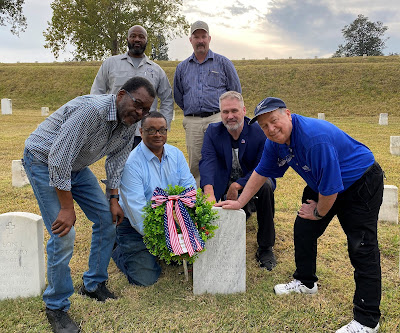
| Photo of Group Honoring Louise Bruce are: James W. Theres, G. Mark LaFrancis, Roscoe Barnes III, Darrell White, Larry Smith, Kilpatrick Wilson and Ryan Hannon |
NATCHEZ, Miss. -- Before the showing of his film “The Six Triple Eight” on
Monday at NAPAC Museum, James Williams Theres, the film’s director and
producer, stopped by the Natchez National Cemetery to honor the late Louise R.
Bruce, who served with the 6888th.
Theres announced that Bruce is a recipient of the Congressional
Gold Medal, an honor bestowed on her as a member of the 6888th Central Postal
Director Battalion.
The medal is considered the U.S. “Congress’s highest
expression of national appreciation for distinguished achievements and
contributions by individuals, institutions or groups,” according to a U.S.
Senate website.
President Biden signed the “Six Triple Eight”
Congressional Gold Medal Act into law in March 2022. Bruce (1913-1996) was one of the 855 black
women in the first and only all-black female battalion who served in Europe
during World War II, according to Theres.
He said her battalion cleared a two-year backlog of mail
and helped to deliver more than 17 million pieces of mail near the end of the
war.
Theres placed a wreath on Bruce’s grave. He was joined by
G. Mark LaFrancis, president of the Home with Heroes Foundation; Roscoe Barnes
III, cultural heritage tourism manager for Visit Natchez; Darrell White, local
historian; Larry Smith, a retired lieutenant colonel in the U.S. Army; and Kilpatrick
Wilson and Ryan Hannon of the Natchez National Cemetery.
“It was an honor to recognize Ms. Bruce’s service to her
country,” said Theres. “Her unit played a critical role in sustaining morale
for the troops overseas in Europe during World War II.”
Smith echoed similar remarks, noting he was fortunate to
participate in the ceremony.
“It was an honor and privilege to pay my respects to Private First Class Louise Bruce, placing a wreath next to her headstone in the Natchez National Cemetery, recognizing her selfless and historic service in the Six-Triple-Eight during the Second World War,” he said. “As a fellow veteran, I’m sure she’d be pleased to know that her service is still recognized today and has not been forgotten by a grateful nation.”
Interestingly, Theres noted, “Bruce is buried not far from Natchez National Cemetery’s only Medal of Honor recipient, U.S. Navy black Civil War veteran, Wilson Brown.”
LaFrancis said The Home with Heroes Foundation was proud
to be a part of the wreath ceremony.
The organization plans to create a photo display with the
6888th in its new Military Museum and Veterans Welcome and Information Center
at 107 Jefferson Davis Blvd., he said.
“I’d like to think that maybe the 6888th might have
helped my father’s mail get to him and to our family during World War II,”
LaFrancis added. “These were extraordinary women.”
Another Natchezian who may have served with the 6888th
was Gwendolyn Mamie Freeman Johnson (1924 – 2017), according to researcher
Marsha Holder, who penned a biographical note about Johnson on Findagrave.com.
When contacted by email, Holder wrote:
“I got on board to help with the 6888th Central Postal
Battalion monument project at Fort Leavenworth back in May 2018. The project
manager, Carlton Philpot, had talked to ‘Gwen Johnson’ previously and from
their conversations and her knowledge about the group, he knew for sure she was
a member of the 6888th.”
To date, no military records show that Johnson was a
member of the 6888th, according to Theres.
However, her membership with the unit is strongly suggested by anecdotal
evidence, he said.
Theres explained there are a few members of the 6888th
who were not identified, and Johnson may well be one of those unnamed
members.
Renza Grennell, mother of former Natchez Mayor Darryl V.
Grennell, said in a recent interview that Johnson was married to her uncle,
James Johnson, and they both served in the military during World War II. Renza
said she did not know what job Gwendolyn did in the military, but she’s certain
that she served with the Women’s Army Corps.
Renza said she remembers when Gwendolyn returned to
Natchez after the war. “I was a little girl then,” she said. “She and her husband
later moved to Chicago where she worked in the post office.”
Renza said Gwendolyn also worked in the Natchez Post
Office. “She may have been the first black who ever worked inside the post
office,” she said. “Then she became a letter carrier.”
NAPAC museum provided a free showing of Theres’ film on
Monday, Nov. 6. The film presented the
history and cultural context of black women serving in the military during the
Second World War.
In addition to interviews with the veterans, the
documentary included historical photographs and stories about the challenges of
the women facing segregation and other Jim Crow practices in the military.
Despite their challenges, however, the film shows that
the women were not only eager to serve, but they also succeeded with their
mission.
Theres noted the stories of the women have garnered
praise and national recognition. He said that even Tyler Perry is working on a
movie about the women of the 6888th.
Betty Lou Hicks, who watched the film, said she thoroughly
enjoyed it. “Those who did not attend missed seeing a fascinating documentary,”
she said. “The story is another little-known but very significant episode in
American history.”
“The documentary was a deeply moving and highly
interesting account of her unit, a story that everyone should see,” said Smith.
“It’s a part of the Bruce family, Natchez, and American history that deserves
to be remembered. I enlisted in 1983 into an Army decades after
integration.
“I served alongside African American women and men of all
ranks. I wish that we had been aware of the contributions of the
Six-Triple-Eight and of inspirational women like PFC Louise Bruce.”
Natchez’s very own Stacy Conde was featured on “Next Stop, Mississippi” on Friday, Nov. 3. She talked about the 3rd Annual Natchez Allumer Light Art Festival set for Friday and Saturday, Nov. 10 and 11.
It starts at 02:22
Listen to her interview here: https://shows.acast.com/5d8932fa719a100a4a0192c0/654532cb8235ab001234e427
NATCHEZ, Miss. — Ser Seshsh Ab Heter-Clifford M. Boxley
says the poster he created earlier this year provides critical details about the
civil rights movement in Natchez, where much of the history springs from the
“yellow house” at 9 St. Catherine St.
During the 1960s, the house served as the home of NAACP
President George Metcalfe and the headquarters for the local NAACP. Today, the
house is known as the Dr. John Banks House or the Dr. John Bowman Banks Museum.
It is also the site of Natchez’s first Mississippi Freedom Trail Marker.
Boxley’s poster is titled, “This No. 9 St. Catherine
Street Yellow House.” It is designed on one side of a 12×18 cardstock with two
black-and-white, historic photos and a colored photo of the yellow house. The
written content, presented like an essay, is about 1,900 words.
The idea for the poster grew out of a concern about “the
whole truth” being told about African American history in Natchez, Boxley said.
For too long, he added, “only the White, European, segregated history was being
promoted.”
Boxley said the public needs to know that the history of
the modern civil rights movement in Natchez came out of the house on St.
Catherine. His poster, he said, is “designed to arm people with what really
happened in the civil rights movement and not just the story of Dr. John Banks”
and his work as a physician. “This is all in the interest of wholistic
history,” he said.
The historical narrative presented on the poster is based
on Boxley’s research and his personal experience in the civil rights movement.
In 1965, when Boxley returned to Natchez to visit his mother, he attended a
meeting with the Natchez Deacons for Defense and Justice, a paramilitary group
that provided armed protection for the civil rights workers and the Black
community.
Boxley said he became a member of the Deacons, and he assisted them with fundraising and acquiring firearms.
Visit ListenUpYall.com here:
https://listenupyall.com/2023/10/26/ser-boxley-creates-poster-on-civil-rights-movement/
Boxley’s poster essay opens with a reference to NAACP President George Metcalfe living at the yellow house and operating a boarding house on the site. He notes the use of the house by many in the civil rights movement.
He writes: “On July 21, 1964, as part of the state-wide
Freedom Summer Project, SNCC (Student Nonviolent Coordinating Committee )
workers returned to Natchez and attempted to organize a Freedom Ballot and
begin a small COFO (Council of Federated Organizations) voter registration
project, with the help of Goerge Metcalfe and the Natchez NAACP at this yellow
house.”
The SNCC members included Dorie Ladner, Chuck McDew and
Charles “Chico” Neblett, Boxley writes, adding Bill Ware, George Greene, and
Burt Watkins also came to Natchez to assist in the movement.
Boxley notes that when members of the Ku Klux Klan tried
to assassinate Ladner and other SNCC members by bombing Freedom House No. 1 at
Jake Fisher’s place in the 600 block of South Wall Street, the ladies stayed at
Metcalfe’s boarding house.
Boxley writes that Metcalfe and his friend, Wharlest
Jackson Sr., were “two strong leaders” who emerged from the house. Both of them
worked at Armstrong Tire and Rubber Company and both were active members of the
NAACP.
Boxley lists the key members of the NAACP who were
instrumental in bringing about change in Natchez. In addition to Metcalfe and
Jackson, he lists Archie Curtis, John Fitzgerald, Mozana Green, Holy Family
Church’s Father Morrissey, George West Sr., Jonathan Grennell, Rayfard Baptist,
and Robert Johnson Sr., among others.
Readers of Boxley’s poster will see detailed information
about the Natchez movement. It features, for example, the harassment Metcalfe
received from the Klan that included threats and shooting into the window of
his home. The essay also covers the Aug. 27, 1965, bombing of Metcalfe’s car by
the Klan, which he survived, but suffered serious injuries.
Also featured is a behind-the-scenes look at the
movement, including the work of the Mississippi Freedom Democratic Party, and
State NAACP Field Director Charles Evers, brother of slain State NAACP leader
Medgar Evers.
Boxley covers the establishment of the Natchez Deacons
for Defense and Justice under the leadership of James “Big Jack” Jackson and
their role in providing armed protection for the black community. He recounts
how the black community, angry and motivated, stood up to the White oppressors.
They held nightly mass meetings and demonstrations. They also called on the
city to denounce the Klan and other white supremacists.
According to Boxley, the Black community’s use of armed
self-defense, economic boycott of white-owned businesses, and enforcement of
the boycott, resulted in the city conceding to the demands of the NAACP.
Boxley ends his essay with a quote by historian Lance
Hill, who wrote, “The Natchez campaign was the single greatest community
victory for the Civil Rights movement in Mississippi.”
For more information:
Boxley’s poster on the civil rights movement is available
for a $10 donation plus $5 for shipping and handling for one copy. Payment
should be made to Friends of Forks of the Road, P.O. Box 2188 Natchez, MS
39121. For more information, call 601-442-4719 or send email to Forksyaroads@aol.com.
Pictured from left: Brother Rogers, retired MDAH historian; Roscoe Barnes III of Visit Natchez; and Caleb Ellison, MDAH program manager. (Cl...